

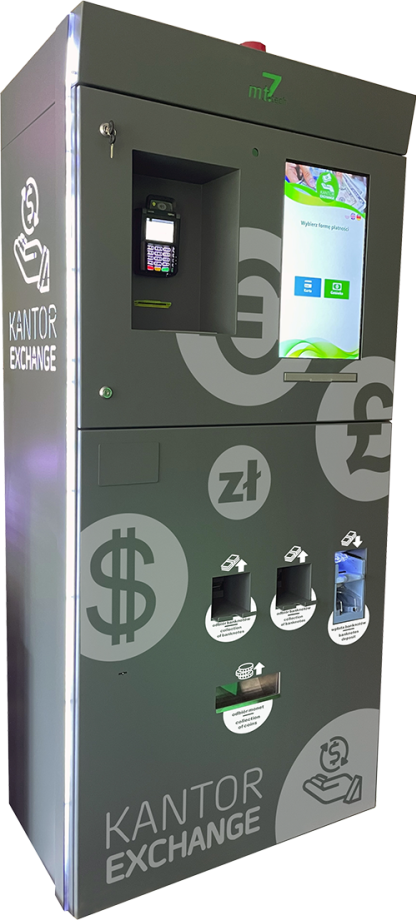
Figures apply to the recommended 4+1.5 layout, as of 2026. A different cassette arrangement is selected for each site.
Currency model
Buy widely, sell selectively
Accepting a wide currency basket does not require a dedicated payout cassette for every currency. Deposits go into the deposit cassette, and the notes for sale stay organised in the DRC compartments.
In the recommended variant the machine buys many currencies and pays out selected ones — typically PLN, EUR, USD and GBP, two denominations each. The final list depends on the validator and the software configuration.
Cash module
4+1.5 configuration
Four DRC cassettes provide eight independent payout compartments. Each DRC has chambers of about 1,200 and about 600 notes. Added to that are the NDC / Acceptance Cassette deposit cassette (about 2,850 notes) and an auxiliary LRB (about 500). Two cash cycles: buy-back goes to deposit, sales come from the DRC.
| Cassette | Role | What it means |
|---|---|---|
| 4 × DRC | Payout | Each cassette has two compartments (about 1,200 and about 600 notes) — 8 independent stores, about 7,200 notes in total. Recommended variant: PLN, EUR, USD, GBP, two denominations each. |
| NDC / Acceptance Cassette | Deposit | Accepted notes (wide-basket buy-back) go into one magazine of about 2,850 notes, not back into the payout cassettes. |
| LRB | Auxiliary | Separates rejected or retracted notes. Capacity about 500 notes. |
Questions
Buying and operations FAQ
- What is an automatic currency exchange kiosk?
- An unattended machine that lets a customer buy or sell currency without a traditional teller counter. The range of transactions depends on the machine configuration and the operator’s policy.
- How many currencies can MT7.tech handle?
- In the recommended layout the machine can buy a wide basket — for example 10 currencies — and pay out selected currencies from dedicated compartments. The final list depends on the validator and the software configuration.
- How does the 4+1.5 configuration work?
- It comprises four DRC cassettes with two compartments each, an NDC / Acceptance Cassette deposit cassette, and an auxiliary LRB.
- How many banknotes does the machine hold?
- Four DRC cassettes provide about 7,200 notes in the payout compartments (about 1,200 and about 600 notes per cassette). The NDC deposit cassette holds about 2,850 notes and the LRB about 500. Figures are published for configuration 4+1.5 (as of 2026).
- Does the machine recycle the same notes it accepts?
- In the recommended layout deposited notes go into the deposit cassette, and DRC compartments are reserved for payout. That keeps stock and denomination setup easier to control.
- Can the operator change the rates?
- Yes. The range and method of rate management depend on the deployed system and the operator’s permissions.
- Can the kiosk be supervised remotely?
- The system can present cash levels, alerts, device status, transactions and reports, and an authorised operator can respond to events.
- Does the machine support AML and PEP checks?
- The machine can support customer identification, document and face verification, statements, and operator control. Legal duties remain with the obliged institution and require up-to-date procedures and a risk assessment.
- Can the machine operate outdoors?
- The enclosure is vandal-resistant and suited for demanding environments. The outdoor variant is specified to match the installation site.
- Where does an automatic currency exchange kiosk make sense?
- In places with currency traffic and a workable cash-handling process: shopping centres, stations, hotels, border crossings, airports. Site selection and commercial assessment stay with the operator.
- How much does an automatic currency exchange kiosk cost?
- The price depends on the note module, security, customer identification, card payments, enclosure, integrations, installation and SLA. There is no catalogue price list — configuration is selected first.
- What does deployment look like?
- The process covers needs and site analysis, currency and denomination setup, agreed integrations, manufacturing, installation, testing, training and service go-live.
- Is service and SLA available?
- Yes. An SLA should specify reporting channels, support hours, response times, parts, inspections and responsibility for cash handling.
Book a consultation and layout selection Download 2026 brochure
Read more
How it works, cassettes, AML, panel, service
These pages are in Polish. They expand on the same machine described here.
- Jak działa kantor automatyczny Klient kupuje lub sprzedaje walutę bez kasjera. Wpłata idzie do depozytu, wypłata schodzi z komór DRC. Szczegóły ścieżki zależą od konfiguracji i polityki operatora.
- Konfiguracja walutowa 4+1.5 Cztery kasety DRC dają osiem komór wypłatowych. Skup szerokiego koszyka nie zużywa osobnej kasety na każdą walutę. Stan na 2026, wariant rekomendowany.
- Jak urządzenie wspiera procedury AML i PEP Kantor automatyczny może wspierać identyfikację klienta i kontrolę operatora. Obowiązki instytucji obowiązanej pozostają po stronie operatora kantoru.
- Panel, raporty i zdalne zarządzanie Operator może na bieżąco widzieć status urządzenia, stany gotówki, alerty i transakcje. Zakres uprawnień ustala wdrożenie.
- Wdrożenie, montaż, serwis i SLA Od analizy lokalizacji po montaż i utrzymanie. Czasy reakcji i zakres SLA zapisujemy w umowie — nie podajemy tu uniwersalnych gwarancji czasowych.
- Cena kantoru automatycznego — od czego zależy Nie publikujemy cennika katalogowego. Kwota wynika z konfiguracji, identyfikacji klienta, obudowy, integracji, montażu i SLA. Najpierw dobieramy wariant do lokalizacji.
- Lokalizacje dla automatycznej wymiany walut Dobór miejsca zależy od ruchu, profilu walut, bezpieczeństwa, obsługi gotówki i dojazdu serwisu. Nie gwarantujemy zwrotu z inwestycji — to ocena operatora.
- Kantor automatyczny czy stanowisko kasjera? Modele różnią się godzinami, obsadą, kontrolą zapasu i kosztem całkowitym. Poniżej porównanie jakościowe — bez fikcyjnych cen i bez obietnicy, że automat zawsze wygrywa.

